Forestry Resources
-

SB 28-18
Forestry and Christmas Trees
Commercial insect and weed control in forestry and Christmas trees. Updated annually.
|
-
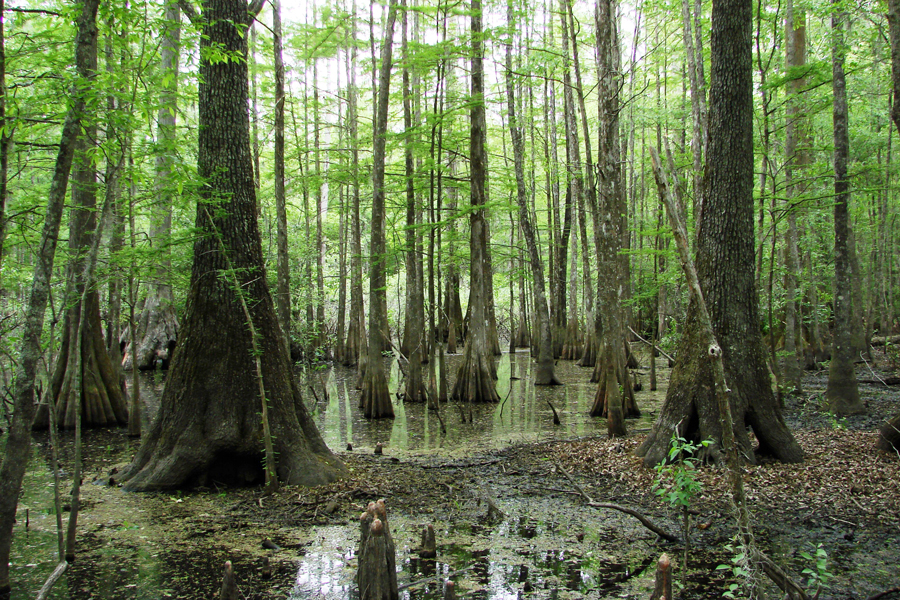
Many people view wetlands as “wastelands,” having few virtues. But it is now known that wetlands provide many useful services, from improving water quality to providing habitat for important fish and wildlife. These kinds of benefits would be costly to create, so maintaining natural wetlands is good for both the economy and the environment. Many smaller wetlands occur in Georgia farmlands, and many of the values provided by wetlands benefit Georgia farmers. This resource highlights the key virtues of wetlands to agriculture, describing how wetlands associated with Georgia farms can contribute to agricultural value.
|
-

AP 130-4-13
Timber Situation and 2026 Outlook
The 2025 market situation: in South Georgia, recent pine sawtimber and pine chip-n-saw prices increased compared to a year ago, while pulpwood prices declined for both pine and hardwood. In North Georgia, stumpage prices for timber products declined compared to a year earlier. The 2026 outlook will be affected by: Demand-side factors expected to shape Georgia’s timber markets in 2026 include a weakened housing market, reduced lumber mill utilization rates, mill closures and conversions, tariffs on import, labor shortages, and overall economic growth; on the supply side, factors include tighter sawtimber inventory in areas impacted by Hurricane Helene, increased timber availability and greater supplies from mill closures in adjacent areas, and ongoing logging capacity constraints. Overall, sawtimber prices in 2026 are expected to remain stable across most of the Georgia, although some areas of South Georgia may experience modest sawtimber price increases.
|
-

David R. Coyle, A. Brady Self, James D. Floyd, and John J. Riggins
Four species of Ips bark beetles (also commonly known as Ips engraver beetles or Ips beetles) occur throughout pure and mixed pine forests in the southeastern U.S.: the six-spined ips (Ips calligraphus), the pine engraver (Ips pini), the eastern five-spined ips (Ips grandicollis), and the small southern pine engraver (Ips avulsus). Ips beetles appear similar to other bark beetles in this region, including the southern pine beetle (SPB), black turpentine beetle, and red turpentine beetle. These beetles occur throughout the entire southeastern U.S., with the exception of the pine engraver and red turpentine beetle, which are found only in the Appalachian region.
|
-

Helene Cser
Extension Associate
North Carolina State University
Leslie Boby
Extension Associate
Southern Regional Extension ForestryResearch and development on alternative sources of energy has been a priority for the United States since volatile energy prices in the 1970’s. This period of time, known as the “Energy Crisis,” occurred due to an oil embargo and limited global supply of oil. To combat these problems, Congress passed the Emergency Petroleum Act in 1973, the Energy Policy and Conservation Act in 1975, and created the Department of Energy in 1977. These congressional acts from more than 30 years ago were the beginnings of a national interest towards developing alternative energy sources. The outcome has been support for research and development of non-petroleum energy sources such as biomass, which is a renewable and carbon neutral source of energy used for heat, electricity and transportation fuels.
|
-

Private forest owners control most of the southern forest resource and are critical to maintaining forest health in the South. Record droughts, rising temperatures, increased frequency and intensity of wildfires, insect and plant invasions, and more intense storm events all pose threats to the health of Southern forests. Scientists project that increases in temperature and changes in rainfall patterns will cause these disturbances to become more common, occurring with greater intensity or duration. This pamphlet reviews healthy forest strategies and approaches to decrease the risks associated with these disturbances on your forestland.
|
-

J. Holly Campbell and David R. Coyle, Southern Regional Extension Forestry
Littleleaf disease is a forest health concern for several pine species in the southeastern United States. This disease is a particular problem for shortleaf pine (Pinus echinata Mill.) and is one reason why this species is less widely planted compared with other pines. Littleleaf disease results from a combination of biological factors and site characteristics, when combined with a susceptible host tree. Some factors are more important – i.e., they have a primary role in disease formation – while others have a secondary role, and mostly contribute to making disease symptoms worse.
|
-

This publication describes forest farming (also known as forest gardening), which can be defined as cultivation of plants under a forest canopy. It includes suggestions for appropriate plants for cultivation in the Southeast.
|
-

Lime mud is a by-product produced in pulp mills as part of the process that turns wood chips into pulp for paper. The pulp mill cooks wood chips with sodium hydroxide to extract the wood fiber used to make paper from the lignin that binds the wood together. During this process, sodium hydroxide is converted to sodium carbonate. The pulp mill than adds calcium oxide, also known as quicklime, to convert the sodium carbonate back to sodium hydroxide in order to use it again. In the process, calcium carbonate is formed.
|